
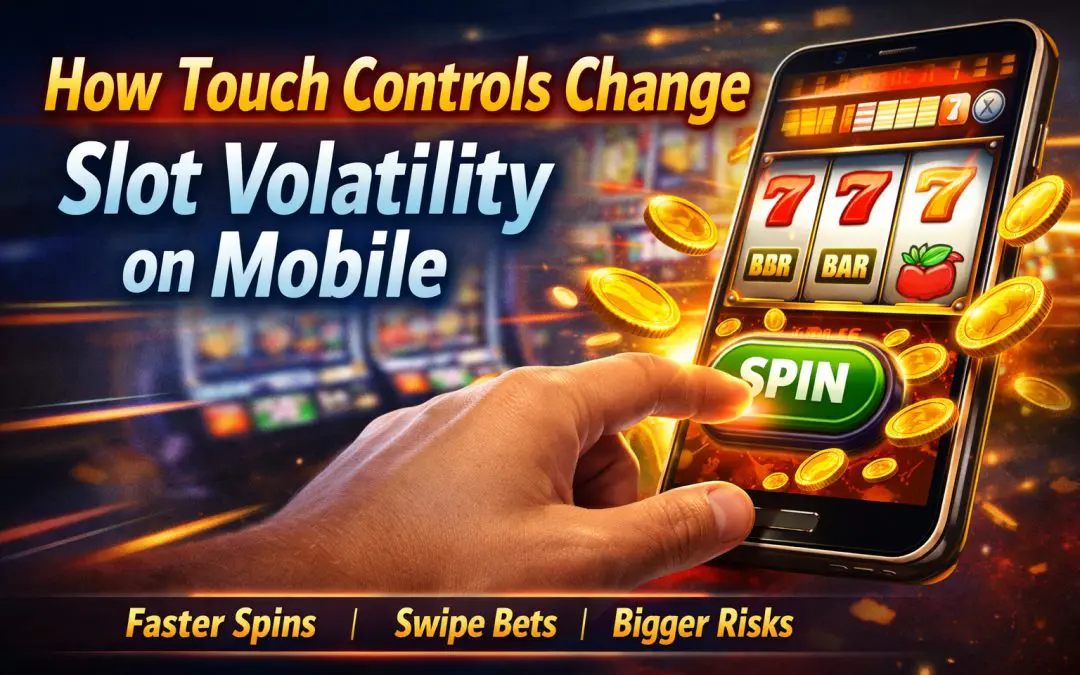
Slot volatility has historically been something that players have felt, rather than managed consciously. When you sit down at a machine, press a button, and wait for an outcome, the timing of those outcomes are largely determined by the mechanical/hardware limitations of the machine. However, mobile gaming changed that dynamic forever. Today, volatility is influenced not only by Return to Player (RTP) percentages, Reel Math, and bonus frequency, but also by how quickly your thumb moves.
Mobile touch screens didn’t change the underlying math behind slot machines. Random Number Generators (RNGs) still generate random numbers independent of how quickly you tap the screen. However, mobile touch controls significantly influence how volatility is perceived. Fast tapping compresses variance into smaller time frames. Gesture-based betting reduces the “friction” associated with increasing stakes. Haptic feedback changes the emotional response to wins and losses. All of these elements alter the outcome of a player’s session in ways that may not be immediately apparent to players.
Understanding the relationship between touch-control slots and volatility provides players with useful tools to leverage when playing mobile slots. It also helps explain why mobile sessions so often seem more frenetic than traditional desktop or land-based sessions.
Traditional Mechanical vs. Modern Touch-Control Slots
Traditional mechanical slot machines imposed a natural rhythm on players. Players had to pull a lever, wait, assess the result of their wager, and then repeat the process. Early digital slots used mouse input to simulate the act of pulling a lever, and while the click was instant, the delay between placing a cursor over a spin button, clicking, and then waiting for an animation to complete, created some “friction.”
Mobile touchscreens eliminated nearly all friction between the player’s intent to spin a reel, and the actual spinning of that reel. Players can initiate a spin with a tap of their finger, and they can accelerate or skip animations by swiping their fingers across the screen. Multi-finger touch inputs allow players to adjust their bets without lifting their hand off the screen. Each of these efficiencies adds up to create a more fluid user experience.
Desktop players may achieve 40-60 spins per minute, depending on animation speed, and their level of distraction. Mobile players may achieve 90-140 spins per minute, when utilizing quick-spin volatility modes, and tap acceleration.
Neither of these differences change the underlying volatility math of the game; however, they do create a compressed volatility exposure environment. A high-variance slot that would typically expose its large swings over 30 minutes, will now expose the same swings in 10 minutes. The compression of volatility exposure increases the emotional intensity of the game, as well as the bankroll fluctuations.
Swipe Interfaces Speed Up Spins Significantly
Swipe reel interactions are a significant factor in creating faster-paced volatility exposure.
Many HTML5 touch frameworks offer swipe functionality to players. While this feature was initially intended to enhance the player experience by allowing players to move through reels quickly, it also creates an environment where volatility exposure is accelerated.
For example, in portrait-oriented Play ‘n Go slots that are optimized for one-handed play, players can use swipe gestures to reduce spin cycle time by as much as 40% or more. In Megaways titles from Big Time Gaming, players utilize rapid taps to move through thousands of reel combinations much more quickly than they were able to on desktop.
Ultimately, the result is the same: variance is delivered to the player at a much faster rate.
Players no longer need to wait for volatility to develop; instead, they create it by accelerating it.
Spin Rate Effect and Variance Compression
Volatility is inherently about the distribution of wins and losses. High-variance slots provide fewer wins, but larger payout amounts. Low-variance slots provide numerous small wins.
Ultimately, over time, the results of both types of slots tend toward the average expected return as defined by the Return to Player percentage.
However, spin speed plays a role in determining how quickly that distribution develops. If a high-volatility slot provides a major bonus approximately once every 200 spins, a slower player may take 30-40 minutes to reach that point. A faster tapper may reach that point in 12 minutes.
The change in perception is substantial. The losses players incur in rapid succession feel more severe than those incurred at a slower rate. Conversely, large wins are perceived as more sudden and dramatic.
As such, players utilizing touch-screen volatility impacts should notice the effects of rapid-fire interaction particularly in mobile environments. Since there is no physical barrier to interaction on mobile devices, and since players do not have to align cursors or otherwise slow their interaction, everything occurs at a faster pace.
Additionally, auto-play acceleration creates an additional layer of volatility. Desktop players often take time to think before initiating auto-play. Additionally, the process of setting-up auto-play requires several mouse-clicks. On mobile devices, auto-play can be initiated with a single tap of the player’s thumb. Therefore, combined with the rapid-fire nature of mobile sessions, bankroll movement occurs at a much faster rate than it does in traditional desktop or land-based environments.
Features Designed to Adjust Volatility Based Upon Touch Inputs
In addition to removing virtually all friction from interaction, mobile touch screens created entirely new volatility-adjustment mechanisms. Players can adjust their volatility exposure using bet-sliders, tap-based increment buttons, and gesture-based betting functions. As such, players can now easily and intuitively change their exposure to volatility.
It is widely understood that the size of a player’s bet directly affects the volatility exposure of a given game in real-world terms. Larger bets amplify the impact of variance. Smaller bets smooth the volatility of a game.
Touch-based bet-scaling removes all friction from adjusting bet-size. Previously, players had to perform several mouse-clicks to increase their bet. On mobile devices, a single swipe of the player’s thumb can adjust bet-size. Such ease-of-use promotes experimentation, but it also promotes impulsive increases in bet-size during periods of emotionally-charged play.
Pragmatic Play, among other developers, utilizes highly responsive sliders in their mobile slot implementations that are designed to work seamlessly with mobile thumb-interaction. Such design elements give players a tactile sense of control, while volatility remains mathematically unchanged.
Players are psychologically affected by their ability to “adjust volatility.” Although players are actually adjusting their volatility-exposure, and not the volatility of the game itself, this sense of control significantly affects their behavior.
Thumb-Friendly Bet Scaling Encourages Higher-Variance Exposure
There is a relatively consistent behavioral pattern exhibited by mobile slot players. During winning-streaks, players increase their bet-size more readily, due to the lack of friction presented by mobile bet-scaling.
Assume that a player adjusts their bet-size from $0.20 to $1.00. On desktop, this would involve five mouse-clicks. On mobile, it would involve a single swipe of the player’s thumb. While this may appear to be a small difference, it changes a player’s behavior. Larger bet-sizes greatly amplify volatility-exposure. Therefore, losses are larger. Wins are larger. Variance has greater impact.
Player behavior regarding mobile slot volatility-controls is generally more dynamic than desktop players’ behaviors. As such, mobile slot volatility-controls create more volatile bankroll-curves.
Gesture-Based Behavior and Risk Patterns
Mobile touch interfaces promote interaction patterns that mouse-controls never could. Gestures are intuitive. Swipes are easy to execute. Taps are effortless. These intuitive actions reduce the psychological barrier between what a player thinks they want to do and the actual act of doing it.
These reduced barriers have clear behavioral implications. For example, players will often chase their losses more aggressively on mobile. Since it is easier to tap the spin-button repeatedly on a mobile device than it is to click the mouse button repeatedly on a desktop, players engage in more rapid-fire interaction. This rapid-fire interaction reinforces emotional engagement.
Further, the interaction becomes sensory, not merely visual. Vibration-win-feedback is utilized in haptic-feedback slots to reinforce the outcome of each spin. Small wins elicit a gentle vibration. Bonuses elicit a stronger pulse. These physical sensations enhance engagement and encourage continued play.
Perceived Volatility Increases Due to Emotional Reinforcement
Haptic-feedback is one of the least recognized volatility-perception modifiers. On traditional slots, wins are visual and auditory. On mobile devices, wins are also tactile. A vibration creates a physical sensation associated with the outcome of the spin. This physical sensation creates a physical memory of the event. The haptic feedback system reinforces the player’s engagement with the volatility swings.
Therefore, small wins feel more satisfying. Losses feel more severe when the vibrations cease. Developers utilizing Unity’s touch-engine can fine-tune the strength and timing of the vibration. Some games utilize progressively-intensifying vibration during bonus rounds to increase tension.
Regardless of whether RTP and volatility math remain unchanged, the tactile element affects how players perceive volatility. As such, players often view high-variance slots as more exciting on mobile, due to the haptic reinforcement of volatility swings.
Portrait Mode and One-Handed Volatility
Portrait mode slots introduced a new behavioral paradigm. Portrait mode allows players to hold their device in portrait orientation and play with one hand. The player uses their thumb to control all aspects of the game: spin, bet-size, auto-play. This ergonomic optimization of mobile devices removes physical friction from the player’s interaction.
Play ‘n Go, NetEnt Touch and other developers have designed their portrait mode slots to fit within the player’s thumb-reach zone. The critical controls (spin, bet-size, auto-play) are placed within the player’s natural thumb-movement area. This design optimizes the player’s interaction speed and frequency. Players spin faster and more frequently because it feels easier. More spins = faster volatility exposure. While this does not increase volatility itself, it does increase the speed at which volatility is exposed.
Auto-Play Acceleration and Touch Interaction
Auto-play existed prior to mobile gaming. However, mobile gaming made it incredibly easy to activate and deactivate auto-play. Players can activate auto-play with a minimal amount of effort and deactivate it with a minimal amount of effort. This ease of activation/deactivation encourages players to toggle back-and-forth between manual and auto-play spins frequently. Players often utilize auto-play during losing streaks to speed through variance cycles, in hopes of reaching a bonus trigger faster. This behavior exposes players to volatility in short bursts.
Mobile volatility UI systems often include gesture-based auto-play controls that allow players to adjust volatility exposure in real-time, and in a dynamic fashion that did not exist in traditional slot gaming environments
Mobile Game Developer Optimizations for Touch Volatility Perception
Mobile game developers have taken an active interest in optimizing mobile slots for optimal use of touch-input. Design optimizations focus on achieving a balance between speed, clarity, and volatility-perception. Examples of common touch-optimization techniques include:
- Large spin buttons positioned in the player’s thumb-reach zone.
- Instant-animation-skipping options activated by a tap gesture.
- Responsive bet-sliders with tactile visual feedback.
- Multi-touch bonus triggers that require rapid interaction.
- Portrait-mode layouts that are designed for one-handed play.
Optimizing mobile slots for touch-interaction improves the accessibility of the game and enhances the player’s overall engagement. The primary benefit of designing mobile slots for optimal touch-interaction is to increase the speed at which volatility is exposed to the player. Developers realize that speed of interaction affects the player’s experience. Therefore, mobile-first slot design places priority on responsiveness above all other considerations.
Multi-Touch Bonus Features and Variance Amplification
Modern mobile slots include multi-touch bonus features. Players may tap multiple objects on the screen during bonus rounds. Other mobile slots utilize swipe gestures to reveal hidden symbols. These gesture-driven bonus-triggers create interactive volatility cycles. While the RNG determines the outcome of the bonus-round, the player perceives themselves to be involved in the outcome. Therefore, the player is emotionally invested in the volatility swings of the game.
Big Time Gaming’s Megaways titles that have been adapted for mobile interaction, often include very interactive bonus-rounds that have been optimized for mobile touch-interaction. Players interact with the volatility of the game more actively, as opposed to passively.
Touch Control and Bankroll Management Consequences
Touch controls have an identifiable effect on bankroll-management. Players burn-through their bankrolls at a faster rate due to the increased spin-rates provided by mobile touch-controls. This is not necessarily an increase in the expected-loss-per-spin, but an increase in the number of total spins-per-session. More spins = more exposure to volatility. To effectively manage bankroll on mobile, players must be aware of the potential for accelerated volatility exposure, and therefore must employ pacing-strategies. Experienced players will often use deliberate pacing to counteract the effects of touch-acceleration.
Some practical touch-volatility management techniques include:
- Using time-based session-limits, rather than spin-based limits.
- Avoiding impulsive increases in bet-size using sliders.
- Disabling quick-spin modes during volatile sessions.
- Taking breaks to break-up the rapid-fire interaction-loops.
- Keeping fixed bet-sizes, regardless of streaks.
Such behaviors allow players to establish control over volatility exposure. Touch controls facilitate volatility, but disciplined players can still manage risk effectively.
Platform Differences: iOS vs Android Touch Behavior
Mobile-platform touch-behavior differs between platforms. The multi-touch capabilities of iOS slots are often more seamless, due to the tight hardware-software integration of Apple products. The Android gesture-API implementation can vary depending upon the hardware of the device. Devices with better refresh rates and lower latency are more responsive, and therefore provide players with a greater sense of control. Better responsiveness leads to faster spin-rates. Faster spin-rates lead to increased volatility-exposure. Therefore, hardware performance indirectly affects volatility-perception. High-performance mobile devices may produce more extreme volatility experiences solely due to the fact that interaction feels faster and smoother.
Future Touch Innovations and Volatility Interaction
Mobile touch technology continues to evolve rapidly. Emerging technologies include: Pressure-Sensitive Touch Controls, Camera Gesture Recognition, Advanced Haptic Systems capable of providing nuanced feedback. The utilization of Pressure-Sensitive Betting will potentially allow players to increase the size of their wagers based on the intensity of their finger-pressure. Camera Gesture Recognition will potentially allow developers to create new bonus-gesture interaction methods. Both of these emerging technologies will likely further entrench players in the volatility of their games. While neither of these technologies will change the mathematical volatility of the